USAAAO — 2026 First Round
Question 21
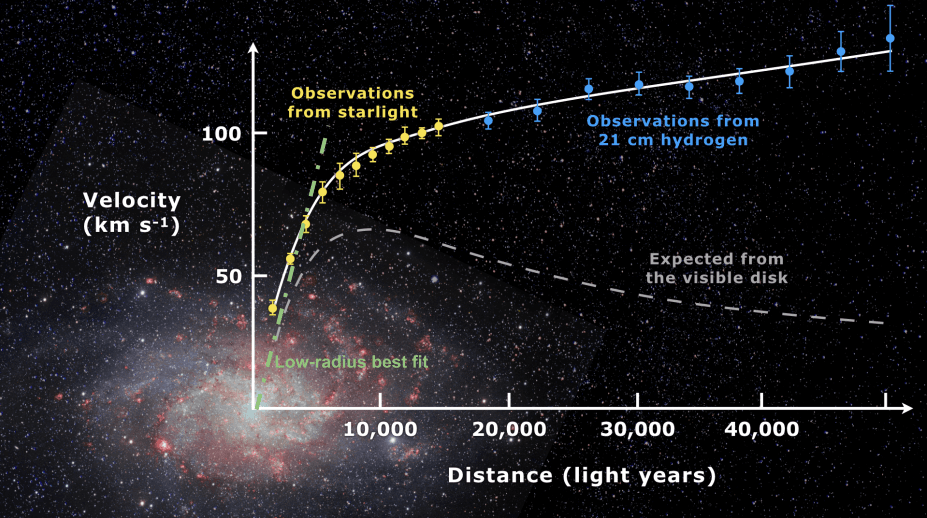
Consider the following graph (below), which shows the mean orbital velocity of stars around a galaxy’s center as a function of distance from the center. The graph also shows the expected orbital velocities (dashed line) from observations of visible matter. The discrepancy between the observed and expected values is assumed to be due to invisible dark matter. Consider orbital radii within the most luminous part of the disk, at around r ≤ 5000 ly. Let M(r) be the total mass (of all forms) enclosed within a distance r from the galactic center. Approximating the rotation curve by the low-radius best fit (dot-dash) line, we can infer that M(r) is roughly proportional to rⁿ for some value of n (over small r). In light of the value of n, and for r ≤ 5000 ly, which of the following hypotheses is MOST consistent with the data?
Sign in to save your progress.
Source
USAAAO 2026 First Round, Question 21. Question text, choices, and answer were transcribed from the official USAAAO exam and solutions PDFs. Official rotation curve omitted; consult cited exam page.