USAAAO — 2022 First Round
Question 14
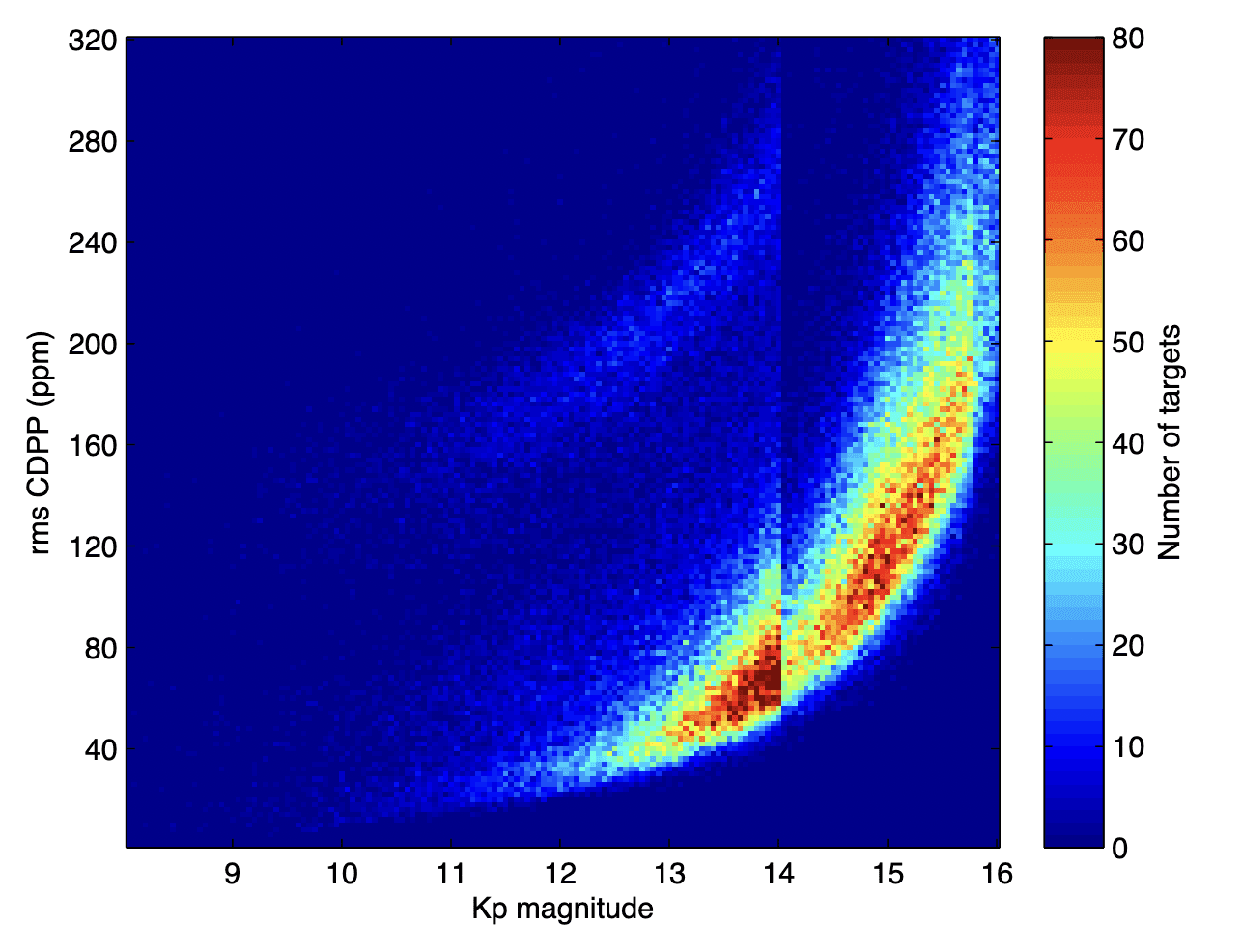
Figure 6 shows a 6-hr root-mean-square (rms) Combined Differential Photometric Precision (CDPP) curve for 150,000 stars observed by the Kepler space telescope. CDPP is a measure of the white noise contained in a light curve, so for a target with 6-hour CDPP of 100 parts per million (ppm), a 6-hour transit with depth 100 ppm would be considered a 1-σ detection. Figure 6: From Christiansen et al. (https://arxiv.org/abs/1208.0595). Original caption: The distri- bution of the 6-hour rms CDPP values with Kp magnitude for all Quarter 3 planetary targets. Consider a 1R☉ target with Kepler magnitude Kp = 13.5 that's among the best targets for its magnitude with respect to noise in Figure 6. Also consider three independent exoplanet scenarios for exoplanets with radii: • I. 0.5 R⊕ • II. 1 R⊕ • III. 10 R⊕ Using a 1 − σ detection threshold (and assuming 6-hour transit durations), which planet(s) transits would we likely fail to observe due to noise?
Sign in to save your progress.
Source
USAAAO 2022 First Round. Question text, choices, and answer were transcribed from the official USAAAO exam and solutions PDFs.